

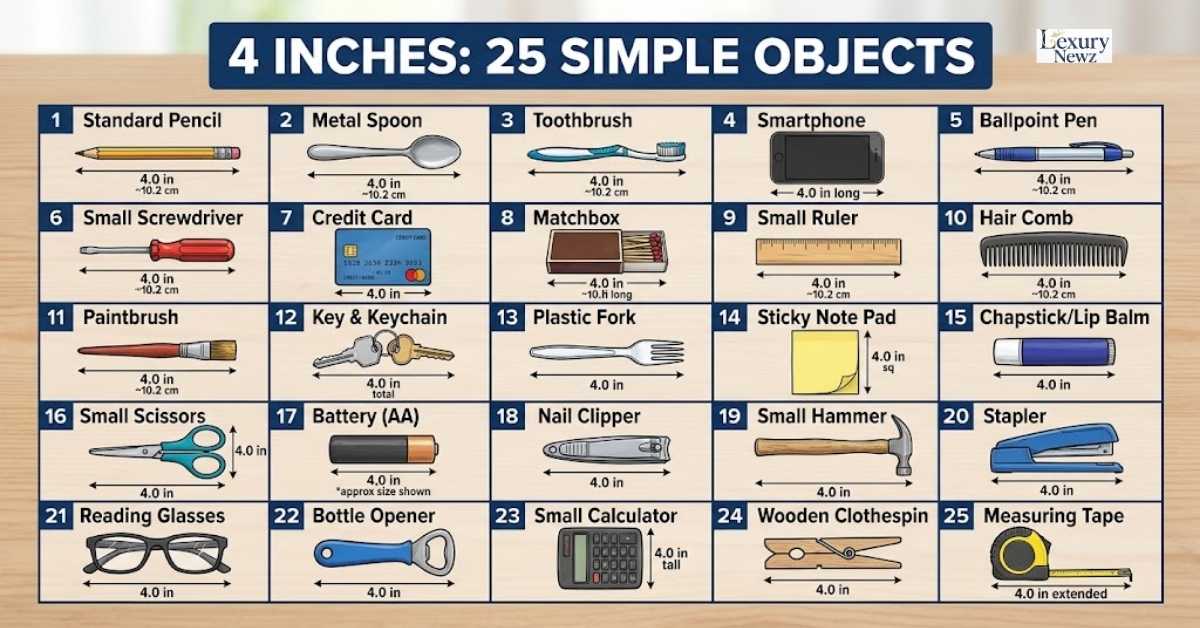
Four inches might sound like a small measurement, but it’s easier to picture with familiar objects.
Four inches equals 10.16 centimeters or 101.6 millimeters. You can use everyday household items to estimate this length when you don’t have a ruler nearby.
This guide explores 25 objects that measure approximately four inches or provide useful size comparisons. You’ll also learn how to measure four inches, convert it into other units, and avoid common estimation mistakes.
What 4 Inches Looks Like in Everyday Life
Four inches is about one-third of a standard 12-inch ruler. Imagine marking the first four inches of a ruler and comparing that distance with objects around your home.
A few familiar items can help you visualize this measurement. However, not every object on this list measures exactly four inches.
- A credit card’s long edge measures about 3.37 inches.
- A standard playing card is usually around 3.5 inches long.
- A 4-by-6-inch index card has a four-inch short side.
- Two AA batteries placed end to end measure approximately four inches.
These comparisons help you build a mental measuring tool. Once you recognize the length, estimating small objects becomes easier.
Example conversation:
“How long is four inches?”
“Picture the short side of a 4-by-6-inch index card. That edge gives you an exact four-inch reference.”
Everyday Objects That Measure Around 4 Inches
Many small household accessories provide useful four-inch size comparisons. You might find suitable examples in your kitchen, office, bathroom, or living room.
Remember that product dimensions vary by brand and design. Check the actual measurements whenever accuracy matters.
1. Small Smart Home Remotes
A small smart home remote can help you visualize a four-inch measurement. Some compact remotes measure around four inches long, although others are considerably longer.
These devices control smart lighting, streaming devices, and other home technology. Their compact design makes them easy to hold and store.
To use one as a size reference, measure its longest side first. Don’t assume every remote matches the same dimensions.
- Typical comparison: Some compact remotes approach four inches in length.
- Useful for: Estimating the size of small electronic accessories.
- Accuracy tip: Check the manufacturer’s specifications before relying on the measurement.
For example, imagine shopping for a small storage tray. A four-inch remote can help you picture the required length, but measure the tray before purchasing it.
2. Travel-Sized Spice Jars
Travel-sized spice jars offer another way to picture four inches. Some compact containers measure close to this height, especially when you include the lid.
These jars hold small amounts of pepper, cinnamon, paprika, or other cooking essentials. Their portable design makes them useful for camping, travel, and compact kitchens.
However, spice containers come in different shapes and sizes. A short glass jar may measure three inches, while another reaches five inches.
- Typical comparison: Around four inches tall for some compact containers.
- Useful for: Visualizing small kitchen storage items.
- Accuracy tip: Measure the container from its base to the top of its lid.
If a recipe calls for a small storage container, this comparison helps you imagine its general size. Always check the actual dimensions when shelf space is limited.
3. Mini Ceramic Espresso Mugs
A mini ceramic espresso mug can help you picture a four-inch height. Some small cups approach this measurement, but many espresso cups stand much shorter.
These mugs hold concentrated coffee servings and often feature thick walls, rounded handles, and compact bases. Their design prioritizes comfortable handling rather than large capacity.
When comparing a mug with four inches, measure its height separately from its handle width. Those dimensions describe different parts of the object.
- Typical comparison: Some compact mugs approach four inches in height.
- Useful for: Visualizing small kitchen accessories.
- Accuracy tip: Check both height and width before comparing cups.
For example, a mug might stand four inches tall but measure only three inches across. That’s why length, width, and height should never be treated as interchangeable measurements.
4. A Folded Microfiber Cloth
A folded microfiber cloth can create a compact shape close to four inches long. The final dimensions depend on the cloth’s original size and how many times you fold it.
People use microfiber cleaning cloths to wipe screens, glasses, kitchen counters, and household surfaces. The fabric folds easily, making it convenient for storage and travel.
For a quick comparison, fold the cloth into a rectangle and measure its longest edge. Adjust the folds until that edge approaches four inches.
- Typical comparison: Varies with the cloth and folding method.
- Useful for: Understanding compact cleaning supplies.
- Accuracy tip: Measure the folded cloth rather than guessing from its original size.
This method also demonstrates how folding changes an object’s dimensions without changing the amount of material.
5. Pocket Notepads
Some pocket notepads measure approximately four inches along one side. Their small format makes them easy to carry in a bag, jacket, or desk drawer.
These notebooks hold reminders, shopping lists, quick sketches, and short notes. Their size also makes them useful examples when comparing stationery.
However, pocket notebooks don’t follow one universal size. Some are narrower than four inches, while others measure considerably more.
- Typical comparison: Around four inches along one side for some models.
- Useful for: Visualizing small office supplies.
- Accuracy tip: Check the notebook’s listed height and width.
Imagine choosing a pouch for your notebook. Knowing its dimensions helps you select a suitable size without relying on appearance alone.
6. Short Succulent Planters
A small succulent planter can provide a useful four-inch reference. Many compact plant pots measure around four inches across the top, although their height and width vary.
These planters hold baby succulents and other small indoor plants. You might place them on a windowsill, office desk, or narrow shelf.
Remember that a planter’s diameter differs from its height. A round pot may measure four inches across while standing only three inches tall.
- Typical comparison: Some nursery pots have a rim near four inches wide.
- Useful for: Visualizing small-space gardening supplies.
- Accuracy tip: Measure across the rim for diameter and from base to rim for height.
This distinction matters when arranging several pots together. Accurate measurements help you plan the available space without overcrowding your plants.
Read More:20 Surprising Things That Weigh 100 Kilograms
7. Compact Soap Dispensers
A compact soap dispenser may measure around four inches tall. Smaller travel models often fit this range, but regular bathroom dispensers can be much taller.
These containers store liquid soap, hand sanitizer, or lotion. Their compact design makes them useful for guest bathrooms, travel bags, and small sinks.
Check the dispenser’s overall height, including its pump. Some models look short because their bodies are wide rather than tall.
- Typical comparison: Some travel dispensers approach four inches in height.
- Useful for: Visualizing bathroom accessories and travel containers.
- Accuracy tip: Measure the full dispenser, including its cap or pump.
For example, a four-inch dispenser may fit beneath a low shelf. A taller model might not, even if both containers hold similar amounts of liquid.
8. Mini Desk Clock

A mini desk clock offers another familiar size comparison. Some compact clocks measure around four inches across or stand close to four inches tall.
These clocks help organize a workspace while adding a decorative touch. Their designs range from simple digital displays to small traditional clock faces.
Don’t confuse the clock’s diameter with its height. A round clock can measure four inches across without measuring four inches from top to bottom when placed on an angled stand.
- Typical comparison: Around four inches in one dimension for some models.
- Useful for: Visualizing desk accessories and compact electronics.
- Accuracy tip: Check the clock’s width, height, and depth.
If you’re organizing a small desk, these measurements help you estimate how much space the clock will occupy.
9. A Square Sticky-Note Pad
A square sticky-note pad can be a convenient reference for small measurements. However, the familiar three-by-three-inch sticky note measures only three inches per side.
Larger sticky-note pads may measure four inches across. Always check the package rather than assuming every pad has the same dimensions.
These stationery items help with reminders, planning, labeling, and workspace organization. Their straight edges also make size comparisons easy.
- Typical comparison: Three inches for common square notes; larger pads may reach four inches.
- Useful for: Comparing small stationery items.
- Accuracy tip: Measure one complete side of the pad.
For example, if your note pad measures four inches across, you can use that edge as a quick reference. If it measures three inches, don’t treat it as an exact four-inch guide.
10. A Folded Charging Cable
A charging cable can help illustrate a four-inch measurement when you arrange part of it in a straight line. Folding the cable into a loop, however, doesn’t create a reliable length reference.
Cable length also differs from the space it occupies when coiled. A six-foot charging cable might form a compact bundle only a few inches wide.
- Typical comparison: The cable’s straightened section can be measured to four inches.
- Useful for: Understanding compact electronic accessories.
- Accuracy tip: Measure a straight section rather than the loop’s width.
For example, lay a charging cord beside a ruler and mark four inches along its length. This gives you a more dependable reference than estimating the size of a tangled cable.
Classic and Highly Recognizable 4 Inches Objects
Some familiar objects help you visualize four inches even when they don’t match the measurement exactly. Their standardized dimensions make them useful references.
The key is understanding how close each object comes to four inches. This prevents small estimation errors from becoming larger problems.
11. The Length of a Credit Card
A standard credit card measures approximately 3.37 inches along its longer edge. That’s shorter than four inches, but it remains a useful everyday size reference.
Most bank cards follow standardized dimensions. Their consistent size makes them more dependable than household objects with widely varying designs.
To picture four inches, compare the card’s long edge with the target measurement. You’ll notice that four inches extends about 0.63 inches beyond the card.
- Standard long edge: Approximately 3.37 inches.
- Four-inch difference: About 0.63 inches.
- Best use: A near-four-inch reference rather than an exact measuring tool.
If someone asks, “What object is 4 inches long?” a credit card offers a familiar starting point. Just remember that its longer edge falls short of four inches.
12. The Long Side of a Playing Card
A standard playing card usually measures about 3.5 inches long. That makes it slightly shorter than four inches, but easy to compare with the target measurement.
Playing cards have fairly consistent dimensions within common card formats. Poker-sized cards generally measure around 2.5 by 3.5 inches.
Place a card beside a ruler to see the difference. Four inches extends approximately half an inch beyond its longer edge.
- Typical long side: About 3.5 inches.
- Difference from four inches: Approximately 0.5 inches.
- Best use: Visualizing a length slightly below four inches.
Playing cards are easy to find at home, during travel, or in a game room. They provide a helpful mental reference, although they’re not an exact four-inch measuring tool.
13. A Smartphone Screen Width
A smartphone can help you picture small measurements, but its screen width varies by model. Many phones have screens narrower than four inches.
Some older compact smartphones featured four-inch displays measured diagonally. That doesn’t mean their screens measured four inches wide.
Screen diagonal, screen width, and phone height describe different dimensions. Confusing them can lead to incorrect size estimates.
- Typical comparison: Many smartphone screens are narrower than four inches.
- Useful for: Understanding compact electronic dimensions.
- Accuracy tip: Check the manufacturer’s screen and device measurements.
For example, a phone with a four-inch diagonal display may measure less than four inches across. If you’re buying a case or storage accessory, use the device’s actual width and height.
14. A Folded Dollar Bill
A US dollar bill measures approximately 6.14 inches long and 2.61 inches wide. Its familiar shape makes it useful for visualizing length, but the bill doesn’t naturally measure four inches.
Folding changes its dimensions depending on the direction and number of folds. A fold across the middle of the long side creates sections roughly three inches long, not four.
- Original length: About 6.14 inches.
- Original width: About 2.61 inches.
- Best use: A familiar reference for estimating smaller lengths.
If you need an accurate four-inch measurement, use a ruler instead of relying on a folded bill. Folding can help with rough estimates, but it doesn’t guarantee an exact result.
15. A Large Cookie
A large bakery cookie can provide a useful four-inch size comparison. Some cookies measure around four inches across, while smaller varieties may measure only two or three inches.
Cookie diameter describes the distance across a round cookie through its center. It doesn’t describe the distance around the outer edge.
- Typical comparison: Some bakery cookies approach four inches in diameter.
- Useful for: Visualizing food portions and baking measurements.
- Accuracy tip: Measure across the widest point.
For example, a recipe might call for cookies that spread to four inches after baking. Measuring the finished cookie helps you judge portion size more accurately.
Keep in mind that dough thickness and baking conditions affect the final result. A four-inch cookie can be thin and crisp or thick and soft.
16. A Small Coaster
A small drink coaster can make four inches easier to picture. Many round coasters measure between three and four inches in diameter, while some square designs have four-inch sides.
Coasters protect tables from moisture and heat. Their flat surfaces also make them easy to compare with rulers and other objects.
- Typical comparison: Around three to four inches across, depending on the design.
- Useful for: Visualizing small household accessories.
- Accuracy tip: Measure from one edge to the opposite edge through the center.
A four-inch square coaster measures four inches wide and four inches long. A round coaster with a four-inch diameter has the same straight-line width across its center.
However, its circumference is much larger than four inches. This difference matters when comparing circular objects.
17. A Small Paint Roller
A mini paint roller can help you visualize four inches, particularly when its roller cover measures that width. Some compact painting tools use four-inch roller covers for small projects.
These tools are useful for painting trim, cabinets, narrow surfaces, and small furniture pieces. Their compact size helps you reach areas that larger rollers cannot handle easily.
- Typical comparison: Some mini roller covers measure four inches wide.
- Useful for: Home improvement and DIY projects.
- Accuracy tip: Check the roller cover’s stated width, not the handle length.
A four-inch roller cover describes the width of its cylindrical surface. It doesn’t mean the entire tool measures four inches long.
That distinction helps when choosing painting tools for a small space.
18. Half the Circumference of a Baseball
A baseball offers an interesting way to understand circular measurements. Its circumference typically measures about 9 to 9.25 inches, so half the circumference is approximately 4.5 to 4.63 inches.
That makes half a baseball’s circumference slightly longer than four inches. More importantly, a curved distance differs from a straight-line measurement.
- Baseball circumference: Approximately 9 to 9.25 inches.
- Half circumference: Approximately 4.5 to 4.63 inches.
- Diameter: Approximately 2.86 to 2.94 inches.
A four-inch circumference example would describe the distance around a circle, not across it.
For a reliable comparison, wrap a flexible measuring tape around the baseball, then measure straight across its center. You’ll see that the diameter is much smaller than the circumference.
Seven More Everyday Objects for a Four-Inch Comparison
The following objects add seven useful comparisons beyond the original 18. Some have standardized dimensions, while others vary by manufacturer.
19. A 4-by-6-Inch Index Card
A standard 4-by-6-inch index card gives you an exact four-inch reference along its shorter side. This makes it one of the most useful objects for visualizing four inches.
Students use index cards for notes, flashcards, study prompts, and quick reminders. Their straight edges also make them easy to compare with other objects.
- Short side: Four inches.
- Long side: Six inches.
- Best use: A reliable four-inch length reference.
Hold the card horizontally and focus on its shorter edge. That edge matches four inches without requiring a rough estimate.
If you need to measure a small shelf space or craft project, an index card can help you visualize the distance. Use a ruler for final measurements when precision matters.
20. Two AA Batteries Placed End to End
Two AA batteries placed end to end measure approximately four inches. A standard AA battery is about 1.97 inches long, so two together reach roughly 3.94 inches.
This makes them a useful comparison for people who keep batteries in household drawers. Their similar size also makes the comparison easy to repeat.
- One AA battery: Approximately 1.97 inches long.
- Two batteries: Approximately 3.94 inches combined.
- Best use: Estimating a length just under four inches.
Place the batteries in a straight line with their ends touching. Don’t overlap them or leave a gap.
This comparison works well for rough estimates around the house. However, use a ruler if you need an exact four-inch measurement for construction or repairs.
21. A 4-by-6-Inch Photo Print
A standard 4-by-6-inch photo print provides another dependable size reference. Its shorter edge measures four inches, while its longer edge measures six inches.
Photo prints are common in albums, frames, school projects, and family displays. Their familiar dimensions make them helpful when planning small decorations.
- Short edge: Four inches.
- Long edge: Six inches.
- Best use: Visualizing photo frames and decorative layouts.
Suppose you want to arrange several photos on a shelf. The short edge helps you estimate how much space each print needs.
Remember that the printed image area may differ slightly if the photo includes a border. Measure the physical paper when accuracy matters.
22. A Four-Inch Common Nail
Some common nails are manufactured to a nominal length of four inches. In US nail sizing, a 20d common nail is traditionally four inches long.
This makes the nail a useful reference in a workshop or home improvement setting. However, nail lengths and styles differ, so check the package before using one for measurement.
- Nominal length: Four inches for a standard 20d common nail.
- Useful for: Understanding construction measurements.
- Accuracy tip: Confirm the nail type and listed length.
A four-inch nail can help you visualize the size of small building materials. It should not replace a ruler when you need precise spacing.
Handle nails carefully because their sharp points can cause injuries. Store them safely after use.
23. A Golf Tee
Some golf tees measure four inches long. However, tee lengths vary, and many common tees are shorter than this.
A golf tee supports a golf ball before a player takes a shot. Longer tees may suit particular clubs or playing preferences.
- Possible length: Four inches for some models.
- Useful for: Visualizing small sports accessories.
- Accuracy tip: Check the package dimensions before treating the tee as a reference.
A four-inch golf tee can help you imagine the length of a small object. Its narrow shape also makes it easy to compare with a ruler.
Don’t assume every tee measures four inches. If you need an exact reference, choose a labeled four-inch model or use a measuring tool.
24. A Standard Stick of Butter
A standard US stick of butter is commonly four inches long. This makes it a convenient kitchen reference when visualizing small measurements.
Butter sticks often include tablespoon markings on their wrappers. Those markings help cooks divide butter into portions without measuring the entire stick.
- Typical length: Four inches.
- Useful for: Baking measurements and kitchen comparisons.
- Accuracy tip: Check the wrapper and measure the stick if exact sizing matters.
Imagine a recipe that calls for a four-inch piece of food. A stick of butter offers a familiar length comparison, even if the actual item has a different shape.
Keep in mind that packaging can affect the overall dimensions. Measure the butter itself when the recipe requires precision.
25. A Compact Cassette Tape
A compact cassette tape measures approximately four inches along its longest side. Its standardized rectangular shape makes it a useful reference for visualizing this length.
Although streaming services have replaced most cassette players, many people still recognize these small music storage devices. Their dimensions make them easy to compare with a ruler or index card.
- Typical long side: About four inches.
- Useful for: Visualizing compact rectangular objects.
- Accuracy tip: Measure the cassette’s longest edge.
A cassette tape also illustrates the difference between length and width. Its longest side approaches four inches, while its shorter side measures less.
If you have an old cassette at home, compare it with a four-inch mark on a ruler. This gives you a clear picture of the measurement.
Why 4 Inches Matters in Daily Life
Four inches appears in everyday measurements more often than you might expect. It can describe the width of a small object, the height of a container, or the length of a tool.
Understanding this measurement helps with practical tasks around the home.
- Home improvement: Estimate the width of small hardware and compact tools.
- Kitchen organization: Compare spice jars, containers, and small accessories.
- Desk organization: Plan space for notebooks, clocks, and electronic accessories.
- Online shopping: Check product dimensions before ordering.
- Craft projects: Measure paper, decorations, and small materials.
For example, a four-inch gap between two objects might determine whether a small storage box fits comfortably. A rough estimate can help you plan, but accurate measurements prevent costly mistakes.
Whenever possible, use a ruler or measuring tape to confirm the final dimensions.
Fun Facts About 4 Inches
Four inches may seem like an ordinary measurement, but it connects several familiar objects and measurement systems.
Here are some useful facts to remember.
- Metric conversion: Four inches equals 10.16 centimeters.
- Millimeters: The same length equals 101.6 millimeters.
- Feet: Four inches equals one-third of a foot.
- Index cards: The short side of a 4-by-6-inch index card measures exactly four inches.
- Credit cards: A standard credit card’s long edge is shorter than four inches.
- Circular measurements: A circle’s circumference is different from its diameter.
- Estimation: Familiar objects can help you visualize four inches, but their dimensions may vary.
One helpful trick is to remember that four inches is slightly longer than ten centimeters. This gives you a quick mental reference when working with metric measurements.
However, ten centimeters and four inches aren’t exactly equal. The difference is 0.16 centimeters, or 1.6 millimeters.
FAQs About 4 Inches
What does 4 inches look like in real life?
4 Inches is about the length of a small index card’s shorter side.
It measures 10.16 centimeters, making it easy to visualize.
How can I measure 4 inches without a ruler?
You can estimate 4 Inches using a four-inch index card or similar object.
For better accuracy, compare your item with a known measurement.
Is 4 inches the same as 10 cm?
No, 4 Inches equals 10.16 centimeters, which is slightly longer than 10 centimeters.
The difference is small but matters when measuring accurately.
Why do so many objects measure around 4 inches?
Many everyday items have compact designs, making 4 Inches a practical size.
You may find this length in small tools, containers, and accessories.
What everyday items are reliable 4-inch references?
A 4-by-6-inch index card has a short side measuring exactly 4 Inches.
Always check an object’s dimensions before using it for accurate measurements.
Correct capitalization of 4 inchesClarify the index card examples
Final Thought
4 Inches may seem like a small measurement, but it appears in many everyday objects. You can find 4 Inches in small tools, index cards, containers, and other household items. These familiar examples make it easier to picture how long 4 Inches really is. Remember, 4 Inches equals 10.16 centimeters or 101.6 millimeters. This simple conversion helps you understand the size in different units. You can also compare 4 Inches with objects around your home to estimate length without a ruler.
The next time you need to picture 4 Inches, use these everyday references as a guide. Check an item’s actual dimensions when accuracy matters because sizes can vary. Whether you’re measuring a small space, shopping online, or working on a DIY project, knowing what 4 Inches looks like can save time. With practice, estimating 4 Inches becomes easier and more useful in daily life.

Logan Pierce is a measurement content writer at Lexury Newz, focused on units, conversions, dimensions, and practical measurement concepts. With an interest in clear research and accurate calculations, Logan creates easy to understand guides that help readers apply measurement information confidently in everyday, educational, and practical situations.